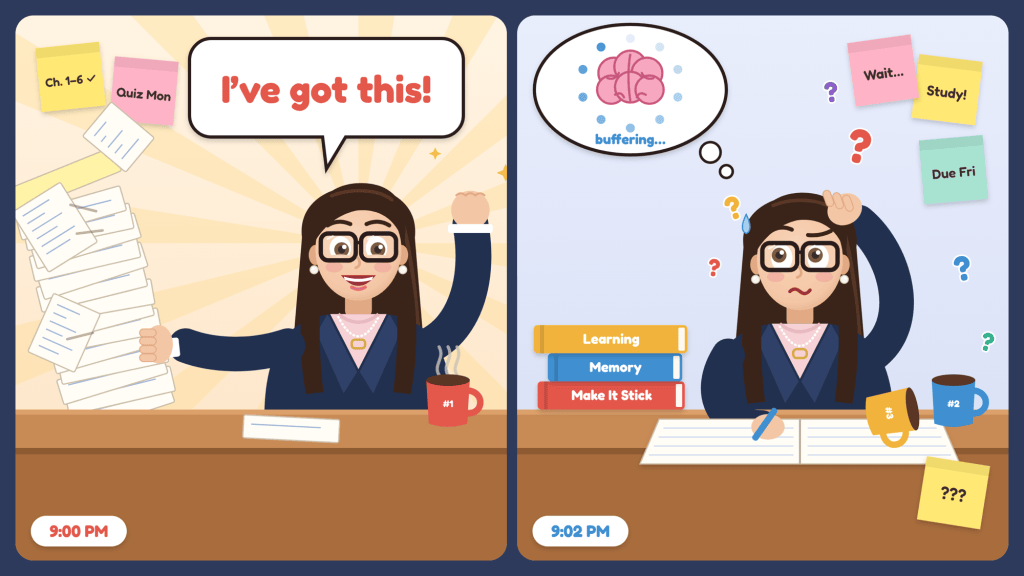
I’ll admit something. When I started my master’s program in my 40s, I went right back to the study habits that got me through my undergraduate studies. I read and listened to on-demand lectures, took helpful notes, and reread those notes until they felt familiar. My memory had always done the rest. When the notes looked familiar, I took that as proof I knew the material.
Then I encountered Dr. Robert Bjork’s work and realized I had been fooling myself for about 25 years.
The intuition that leads us wrong
Bjork, a cognitive psychologist at UCLA, has spent his career studying a frustrating fact: what feels like learning and what actually produces learning are often opposites. We judge how well we’re learning by how easy it feels. If the material flows and practice goes smoothly, we assume it is sticking. If it feels slow and clumsy, we assume something is wrong.
He makes a distinction between performance and learning. Performance is what you can do right now, during or immediately after practice. Learning is the lasting change that shows up days or weeks later, when you need it. The two do not always line up. Strategies that improve performance in the moment, such as rereading or cramming, may create a sense of fluency without producing the same level of long-term retention. Strategies that feel harder in the moment often produce more durable learning.
Bjork calls these desirable difficulties. A few of the big ones include:
- Retrieval practice instead of rereading.Pulling information out of your memory by quizzing yourself or explaining it without notes strengthens it more than simply putting the information back in again.
- Spacing instead of cramming. Allowing a little forgetting to happen between study sessions makes the next retrieval more difficult, and that effort helps strengthen the memory.
- Interleaving instead of blocking. Mixing different topics or problem types feels messier than practicing one thing at a time, but it helps you distinguish among them and select the right approach.
The faulty intuition underlying all of this is that ease means mastery. Rereading feels productive because the text becomes familiar. But familiarity is recognition, not recall.
What this looked like for me
Rereading worked well enough for me in college, or at least I thought it did. What I did not notice was how much of the material faded once the exam was over. Familiar is not the same as known. I could recognize my notes, but I could not always rebuild the ideas without them.
Now I am trying something less comfortable. After a reading or lecture, I open a blank page in OneNote, hide my notes, and type everything I can remember before looking back. The writing itself does not take long. What is difficult is discovering what I cannot retrieve on my own. Then I compare my response with my notes, highlight what I missed, and use those gaps to create my study list. A week or two later, I do it again.
Where I see it at work
This has also changed how I think about workplace learning. Organizations often jump straight to “we need a course” without first asking what is actually preventing people from performing effectively. Sometimes the answer is training, but sometimes it is a process, system, communication, or resource issue.
Bjork’s research adds another consideration. When people are asked how they prefer to learn, they may naturally choose options that feel smooth and efficient, such as a recorded session, a quick reference guide, or a single day of training. Those options can be useful, but ease and convenience do not necessarily produce lasting learning.
This means listening carefully to what learners need while also designing learning around evidence. The most effective experience may include opportunities to retrieve information, revisit it over time, apply it in different situations, make mistakes, receive feedback, and try again. It may feel less efficient in the moment, but it is more likely to support learning that lasts.
Changing the behavior
What I am trying to practice, both as a student and as someone who designs learning for others, is straightforward:
- Do not trust the feeling of fluency. Ask, “Could I explain this without my notes?”
- Test before reviewing. Retrieve first, then check.
- Space it out. Revisit older material on purpose, after I have started to forget it.
- Mix it up. Practice concepts side by side so I learn when each one applies.
- Reframe struggle. If it feels hard, that may be the learning happening.
The hardest part is not knowing these strategies. It is trusting them when every instinct says the easy way is working. I am still working on that one.
References
Bjork, E. L., & Bjork, R. A. (2011). Making things hard on yourself, but in a good way: Creating desirable difficulties to enhance learning. In M. A. Gernsbacher, R. W. Pew, L. M. Hough, & J. R. Pomerantz (Eds.), Psychology and the real world: Essays illustrating fundamental contributions to society (pp. 56–64). Worth Publishers.
Brown, P. C., Roediger, H. L., III, & McDaniel, M. A. (2014). Make it stick: The science of successful learning. Belknap Press of Harvard University Press.
Soderstrom, N. C., & Bjork, R. A. (2015). Learning versus performance: An integrative review. Perspectives on Psychological Science, 10(2), 176–199.


Leave a Reply